HPU Research and Innovation: November 2023
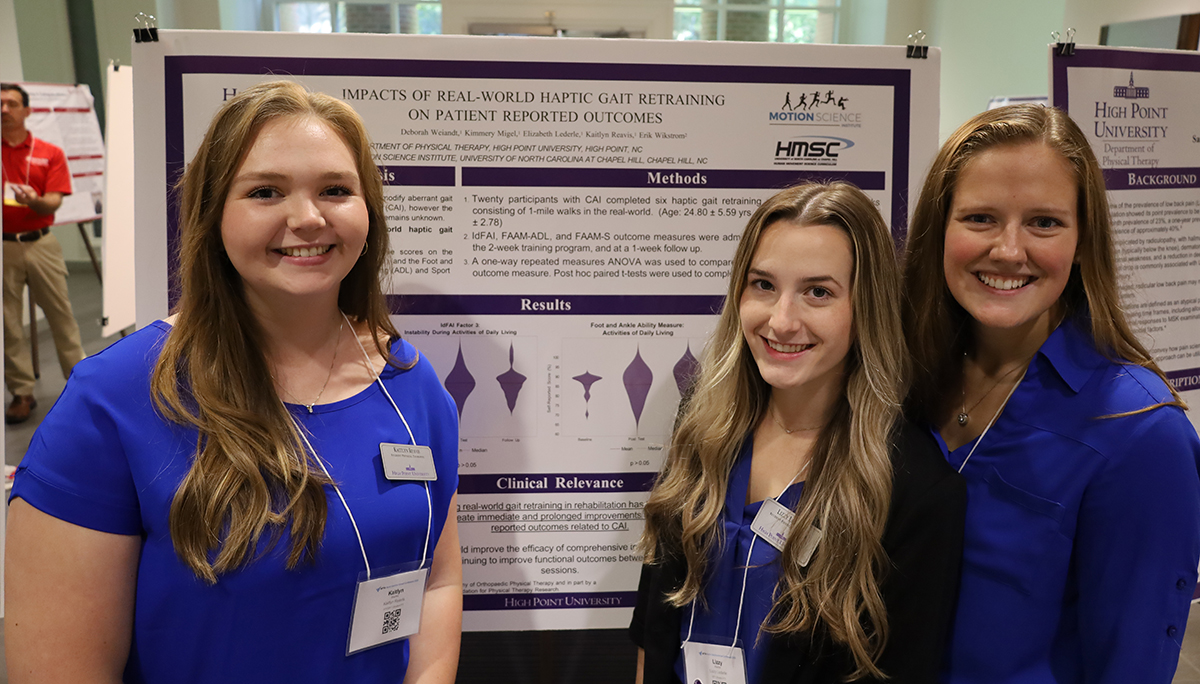
From left, Kaitlyn Reavis, Elizabeth Lederle and Deborah Weiandt won the Best Student Research Award at the annual conference of the American Physical Therapy Association of North Carolina (APTANC).
HIGH POINT, N.C., Nov. 27, 2023 – Members of the High Point University community frequently conduct, publish and share research and creative works in a variety of ways. Below is a recap of recent research and innovation initiatives.
Physical Therapy Students Awarded for Research
Sixty HPU Department of Physical Therapy (DPT) students recently presented their research at the annual conference of the American Physical Therapy Association of North Carolina (APTANC).
The Best Student Research Award was presented to HPU PT students Deborah Weiandt, Elizabeth Lederle and Kaitlyn Reavis. Dr. Kimmery Migel, an assistant professor of physical therapy, was the faculty author of the winning research project.
“We have been extremely grateful for the experiences that have been provided to us as students at High Point University in the DPT program, including the research opportunities,” said Weiandt, first author of the winning research project. “We are also especially thankful to Dr. Migel, who has taught us and let us be involved in her research and bring it to present at the APTA conference.”

Melissa Escudero won a student delegate award and a $1,250 scholarship, which will go toward her travels to Washington, D.C., to participate as a student delegate in parliamentary procedures through the APTA House of Delegates.
“I am extremely honored to be the recipient of this year’s APTA Student Delegate Scholarship,” said Escudero. “I am always eager to be engaged in our profession beyond the classroom. I am looking forward to furthering my dedication in the world of PT as an evolving clinician.”
HPU students made three short speeches on research and 29 poster presentations out of 63 total at the state conference. Ten DPT clinical faculty members, seven core faculty and three faculty members from other HPU departments, were involved and attended the annual conference.
“We strongly encourage experiential learning opportunities that allow our students to grow beyond the boundaries of the classroom,” said Dr. Lance Mabry, an assistant professor of physical therapy in the Congdon School of Health Sciences. “These students are demonstrating the life skills necessary to become leaders within the profession and pillars within society.”
History Professors’ Greenhouse Project Earns Grant
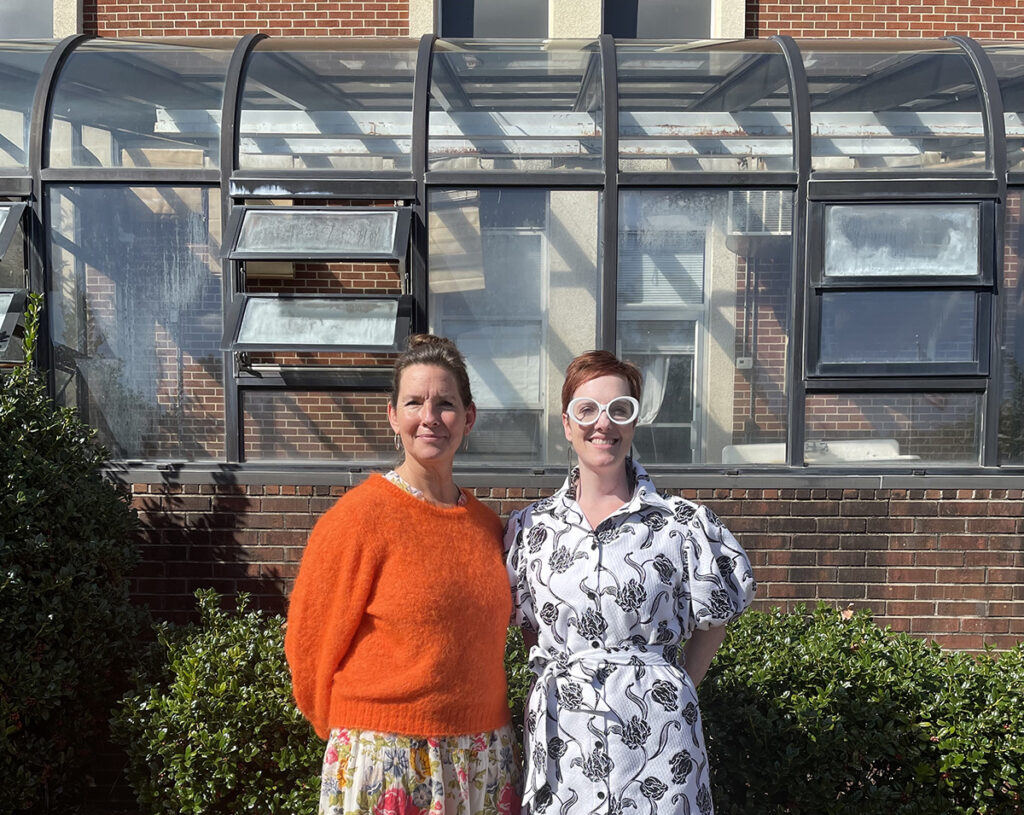
Dr. Amanda Allen, assistant professor of history, and Dr. Shannon Lalor, instructor of history, recently received a North Carolina Humanities’ Community Engagement Grant to create a Medieval and Early Modern greenhouse on HPU’s campus.
Using the Couch Greenhouse in the spring semester, Allen and Lalor will guide students in growing plants indicative of Medieval and Early Modern European medicinal gardens. Relying on extensive digitized medical and botany manuscripts from the eras, the project will bring medical history to life. In addition to growing various medicinal plants, the greenhouse will be turned into a public history display featuring signage detailing the plants, their historical uses and highlighting the manuscript research.
In connection with HPU Gardens, the completed public history display will be linked with the garden tour route for visitors. Additionally, the project will be linked with Old Salem and the High Point Museum, which both feature early American medicinal gardens and related educational programming. The Greenhouse Garden Project webpage, connected with the HPU Gardens website, will link with the High Point Museum’s app to connect both gardens and explain the continuity of medical practice from the medieval and early modern eras to early America as Europeans settled and adapted European practices with those of Indigenous Americans and enslaved persons from Africa. Funding from this grant will help cultivate a historical medicine garden network in the Triad. The Couch Greenhouse on campus will remain wholly unique with its earlier medieval/early modern emphasis and bring in a missing part of this historical mission.
“We are thrilled to introduce students to the history of medicinal plants in an experiential learning laboratory environment,” said Lalor. “The opportunity to see the Couch Greenhouse transformed through funding from the N.C. Endowment for the Humanities into an inspiring environment for our students supports the larger goal of the History Department to highlight the importance of the study of history and its connections to many diverse fields of study. Medicinal plants were integral to medieval Europe and to the imperial projects of Spain and England, propelling these empires across the Atlantic into the Western hemisphere. We’re excited to share this knowledge with students and campus visitors alike.”
Allen added they hope this project will continue to grow after the grant is completed. She noted it not only provides a unique historical focus but allows HPU history majors to work on a growing aspect of medical history, conduct research, connect with a grant and participate in HPU’s experiential learning emphasis.
“In the long run we hope to keep this greenhouse available as a history lab, keep expanding with the HPU gardens, continuing work with the High Point Museum on building their medical history educational programming, and provide unique-to-HPU courses,” said Allen.
Allen created an integrative course for next year with Dr. Jeremy Whitson, assistant professor of biology, in which students will continue to grow certain plants, use historical research to create Medieval/Early Modern medicinal treatments, and in the laboratory test the various properties of these treatments to find why, or why not, these botanical treatments were effective.
Professor’s Project Earns Civic and Voter Engagement Award
Allison Walker, HPU’s director of service learning and an instructor of English, recently received a $1,000 Civic and Voter Fellowship Award in the Deliberative Dialogue track for fall 2023 and spring 2024. This is funded by a $900,000 grant from the Mellon Foundation with additional support from The Eugene M. Lang Foundation. The initiative supports faculty to integrate voter education and social justice issues into humanities curricula through deliberative dialogue and community-initiated projects.
“The Civic and Voter Engagement Fellowship is part of Project Pericles, a three-year initiative called ‘Curricula for Social Change: Empowering College Faculty, Students and Communities through Voter Engagement,’” said Walker. “By incorporating academic content with civic issues students are passionate about, Project Pericles will transform the lives of hundreds of faculty, thousands of students and more than 50 communities across the nation by empowering them with the skills and resources necessary to build a more inclusive and equitable society.”

Founded in 2001 by Lang, Project Pericles is a not-for-profit organization that encourages and facilitates commitments by colleges and universities to include social responsibility and participatory citizenship as essential elements of their educational programs. Project Pericles works directly with its member institutions as they individually and collaboratively develop model civic engagement programs in their classrooms, on their campuses and in their communities. Project Pericles works to incorporate civic engagement and social responsibility in areas including curriculum and faculty development, research into best practices and student engagement. In addition, Project Pericles works with faculty from more than 50 colleges and universities.
In alignment with HPU’s commitment to enriching cultural and intellectual life, the Center for Community Engagement and the School of Humanities and Behavioral Sciences will present a three-part Deliberative Dialogue Series developed in the fall of 2023 and implemented in the spring of 2024. This series seeks to engage students and faculty in meaningful dialogue, facilitate interdisciplinary collaboration and actively contribute to the university’s mission, notably within the context of High Point University’s Centennial celebration and the institution’s broader Academic Strategic Plan.