HPU Poll: North Carolinians Say They are Aware of the Upcoming Solar Eclipse
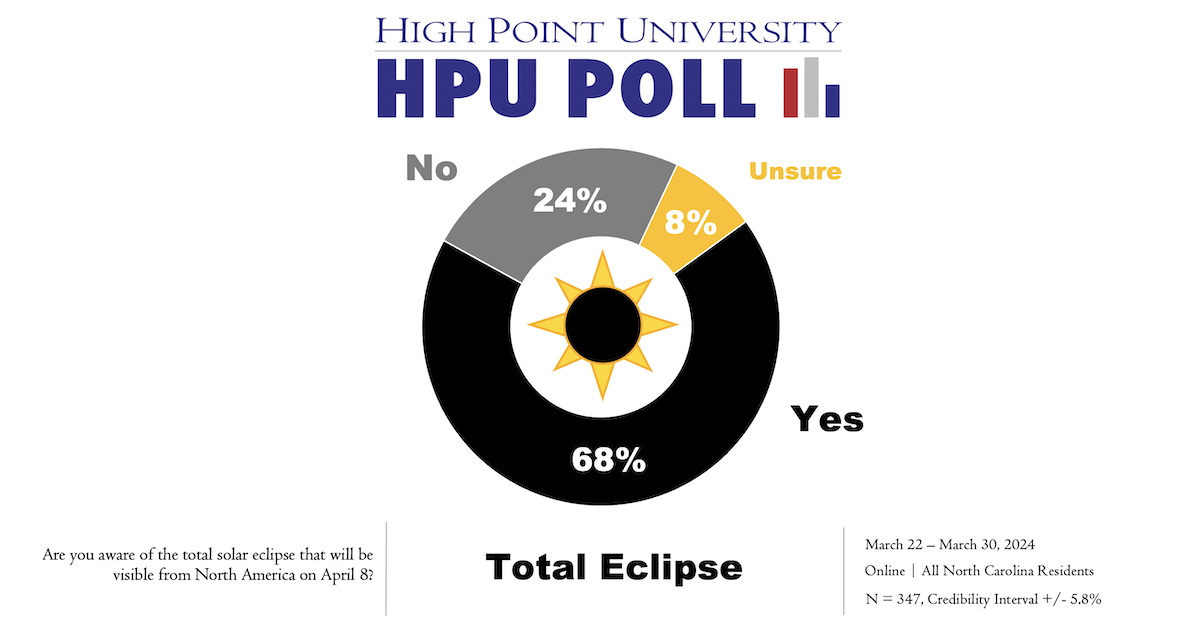
HIGH POINT, N.C., April 5, 2024 – The latest High Point University Poll finds that a majority (68%) of North Carolinians said they are aware of the total solar eclipse that will be visible from North America on Monday, April 8, when the moon will partially or completely block the sun. Another quarter (24%) said that they are not aware of the imminent solar eclipse, and 8% didn’t provide an opinion.
North Carolina is not in the pathway of totality for 2024, meaning that from the perspective of North Carolinians, the sun will not be completely covered during the eclipse.
Respondents were split on how or if they were viewing the eclipse. More than half (55%) said they plan to view the eclipse either directly (32%) or electronically (23%) on a television, computer, tablet or smart phone. Many respondents said they are either not planning to view the eclipse at all (22%) or are unsure what they will do (23%).
Scientific Knowledge about the Earth and Sun
Most North Carolinians (69%) understand that the Earth orbits the sun, while another 16% think the sun orbits the Earth and 15% were unsure. When asked how often the Earth orbits around the sun, a majority (62%) responded correctly that it happens once a year. A little more than a quarter (29%) said once a day, and 5% said once a month. Another 5% were unsure.
“Solar eclipses are one of nature’s great spectacles, so I encourage anyone and everyone to take advantage of this chance,” said Jeff Regester, instructor of physics and astronomy at HPU. “Usually the sky, if we even bother to look at it during our busy lives, looks almost flat. During an eclipse, however, literally one thing is passing in front of another, and that is very striking. From beginning to end, the eclipse will last about 2.5 hours. So, look a few times throughout the eclipse time window to see the moon progress across the face of the sun. Be sure to wear certified eclipse glasses to protect your eyes and enjoy the show.”
N.C. Residents – Solar Eclipse (March 2024)
Are you aware of the total solar eclipse that will be visible from North America on April 8, 2024, when the moon will partially or completely block the sun (depending on observing location)?
Yes – 68%
No – 24%
Unsure – 8%
Do you plan to view the eclipse on April 8, 2024, directly (in person) or electronically (on a television, computer, tablet or smart phone screen)?
Directly – 32%
Electronically – 23%
I do not plan to view the eclipse – 22%
Unsure – 23%
Does the Earth orbit the sun, or does the sun orbit the Earth?
Earth orbits around the sun – 69%
Sun orbits around the Earth – 16%
Unsure – 15%
Does the Earth orbit around the sun once a day, once a month, or once a year?
Once a day – 29%
Once of month – 5%
Once a year – 62%
Unsure – 5%
HPU Poll 102 was fielded by the High Point University Survey Research Center on March 22 through March 30 as an online survey using a panel of respondents recruited and maintained by Dynata. Dynata sent invitations to its panel of N.C. respondents and the SRC collected 1,016 total responses on its Qualtrics platform. The items reported in this release were presented to one-third of the total respondents for an effect sample size of 347. The SRC verified that the demographics of this sub-sample were similar to those of the full sample. The SRC did all data analysis. The online sample is from a panel of respondents, and their participation does not adhere to usual assumptions associated with random selection. Therefore, it is not appropriate to assign a classic margin of sampling error for the results. In this case, the SRC provides a credibility interval of plus or minus 3.4 percentage points to account for a traditional 95% confidence interval for the estimates (plus or minus 3.1 percentage points) and a design effect of 1.2 (based on the weighting). For the sub-sample, the credibility interval is plus or minus 5.8 percentage points (5.3 adjusted to account for a design effect of 1.2 based on the weighting). The data is weighted toward population estimates for age, gender, race, ethnicity and education based on U.S. Census numbers for North Carolina. Factors such as question wording and other methodological choices in conducting survey research can introduce additional errors into the findings of opinion polls. Percentages may not add to 100 because of rounding.
Further results and methodological details from the most recent survey and past surveys can be found at the Survey Research Center website. Materials online include past press releases as well as memos summarizing the findings (including approval ratings) for each poll since 2010.
The HPU Poll reports methodological details in accordance with the standards set out by AAPOR’s Transparency Initiative, and the HPU Survey Research Center is a Charter Member of the Initiative.
You can follow the HPU Poll on X.
Dr. Martin Kifer, chair and associate professor of political science, serves as the director of the HPU Poll, and Brian McDonald is the associate director of the HPU Poll.